He is Risen! He is Risen indeed!
It’s Easter Sunday today. At church this morning we played the “Easter Hymn” – “Christ The Lord Is Risen Today”. It’s a terrific hymn, one of my personal favourites, a real banger (like the cool kids probably don’t say these days). I wish we played it more often, but it’s very much a seasonal hymn – like Christmas carols.
The band this morning was Phil playing acoustic guitar and singing, Kate playing piano, and myself playing electric bass for three songs and trumpet for the Easter Hymn. Unlike last month, the trumpet seemed to sit better in the ensemble this morning. Having the piano helped.
For a Sunday morning service with a small ensemble such as this morning, I think the trumpet’s role is to provide some variation in the texture of the music – some different colours, if you like.
With a song that’s as well known as the Easter Hymn, and with a singer leading, there’s no need to have another instrument play the melody. The accompaniment of a piano and acoustic guitar can provide dynamic contrast – louder, more assertive, or softer, more reflective – but not much variation in texture or colour. They could, but we don’t usually have the rehearsal time to work that out!
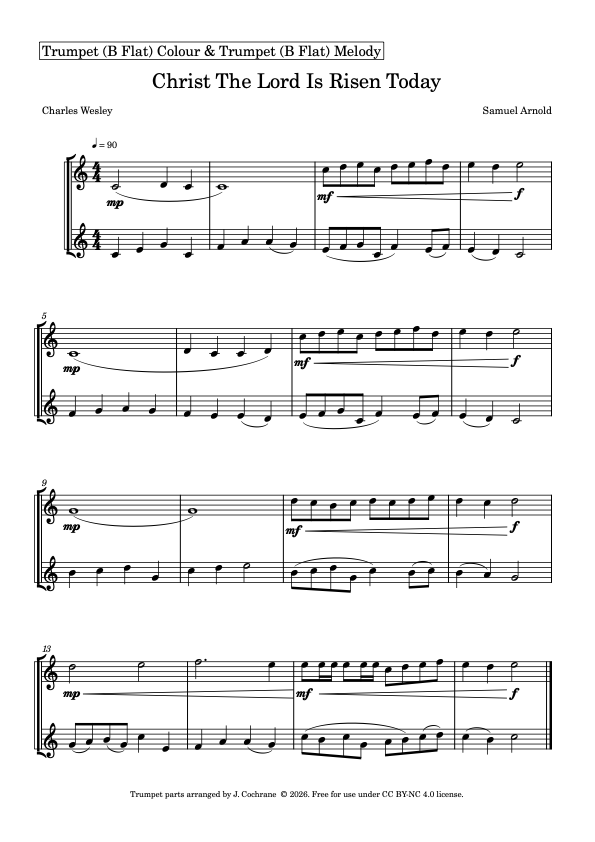
In preparation I spent a few hours on Saturday writing what I’ve called a “colour” part. In some places it’s sort of an alto part sitting under the melody, and in other places a celebratory fanfare or descant.
“Christ the Lord is Risen Today” has a slightly uncommon structure for a hymn. At the top level, it has the usual hymn structure of four lines arranged in the pattern A-A’-B-C, but each line is a call and response. The first line, an example, goes “Jesus Christ is risen today” – the call, and “Alleluia” – the response.
For my “colour” part I decided to play a part with sustained notes at mp (mezzo-piano, moderately quiet) under the call, then shift to a fanfare or descant for the response. Because if there’s one word that always needs a trumpet fanfare, it’s “Alleluia”!
The trumpet line weaves around the melody to provide one colour for the call and a contrasting colour for the response. See the image below for more detail of the parts (or download them as a PDF).
Even with just two written lines, you can create quite a bit of variation between verses. This morning we played four verses. For the first one, I just played the melody. For the second one, I only played the melody of the Alleluias. I think I played the entire colour part for the third and fourth verses – although to be honest I was concentrating so hard on breathing and pitch and dynamics and articulation that I don’t remember what I actually played!
Happy Easter!
Revised April 6th, 2026 to make the traditional Easter greeting display text.